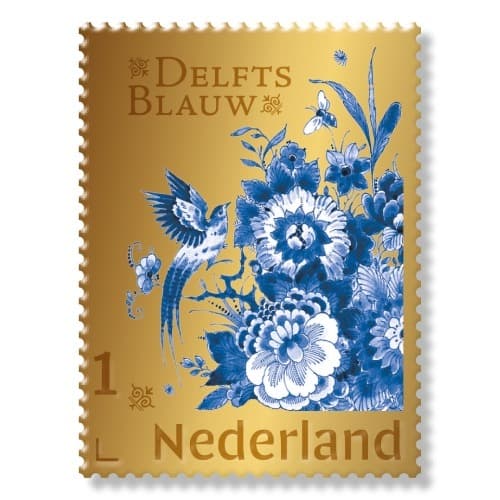
On 28 September 2026, PostNL issued the Postzegel met Goud – Delfts Blauw (Stamp with Gold – Delft Blue), a 24-carat gold stamp that follows the world's first Delft Blue ceramic stamp, released three weeks earlier. Like its ceramic predecessor, this issue is a collaboration with Royal Delft — the last surviving Delftware factory in the Netherlands, founded as De Porceleyne Fles in 1653 — and takes one of the Netherlands' most iconic crafts and reimagines it in gold.
The Postzegel met Goud – Delfts Blauw shows a detail of an illustration taken from a dish in the collection of Royal Delft. The stamp is a single piece, produced in a strictly limited edition of just 1,000 stamps, with a serrated (perforated) edge. It is supplied in a luxe passe-partout presentation and even comes with its own certificate of authenticity, with the certificate's stamp-like data blocks printed in gold to match the stamp.
A Golden Sequel to the Ceramic Stamp
The Postzegel met Goud – Delfts Blauw follows directly on the Delfts Blauw Keramiekpostzegel, which PostNL issued on 7 September 2026 to a design by Royal Delft — the first postage stamp in Dutch history made of genuine ceramic. Where the ceramic stamp was a thin, five centimetre tile, the gold stamp distils the same Delft Blue imagery onto a 30 × 40 mm vertical stamp, its entire background rendered in gold.
Together, the two issues form a remarkable pair: one object in fired, tin-glazed clay, the other in precious metal. Both carry a value indication of 1, valid for post up to 20 grams within the Netherlands, and both bring the centuries-old vocabulary of Delft Blue — flowers, birds and ornament — into the hands of collectors.
Designed in Gold by Frank Janse
The Postzegel met Goud – Delfts Blauw was designed by Frank Janse. "I visited the Royal Delft workshop to immerse myself in the characteristics of their designs," Janse explains. "It was great fun and inspiring to see their products with my own eyes. Their decorations must comply with all kinds of rules about composition, colour use and colour gradation."
Janse searched for a fitting image for so small a vertical surface. "I asked myself whether the image should resemble the ceramic stamp or deliberately not. I also looked at relatively modern decorations on tiles — such as windmills — but that became too clichéd, and in the end, in consultation with PostNL, I chose flowers and a bird, the motifs most often depicted on early 17th-century Delft Blue."
"The bird is probably a fantasy bird, derived from original depictions on Chinese blue-and-white porcelain. Those often showed small songbirds among peonies and blossom branches." For the stamp itself, Janse made the entire background gold, and on the certificate of authenticity the stamp-like blocks holding the data are likewise printed in gold.
For the packaging, Janse had a number of elements printed in gold so that the whole appeared painted. To make clear at a glance that the package contains a stamp, he added a thin gold serrated edge along the top and bottom. He set the design in the Jenson typeface — a classic serif chosen for its natural, legible and harmonious character, and a good match for the subject. The titles on the stamp, the packaging and the certificate of authenticity are finished with the small ornaments often seen in the corners of Delft Blue tiles — including one in the lower-left corner of the stamp.
Frank Janse (Vlissingen, 1967) graduated as a graphic designer from the Willem de Kooning Academy in Rotterdam in 2001. A specialist in house styles, branding, infographics and communication campaigns, he has worked for various advertising and design agencies, including Room for ID's, and independently as Frank Grafisch Ontwerp in Gouda.
The Story of Delft Blue
Delft Blue is a type of earthenware with blue decorations that has been made in Delft since the 17th century. It is known to enthusiasts all over the world, and Delft Blue tiles, ornamental plates, tableware, apothecary bottles and vases are exhibited in many museums.
In the 17th century, Chinese blue-and-white porcelain was enormously popular in the Republic of the Seven United Netherlands, as the Netherlands was then called. The prosperity of the Dutch Golden Age created great demand for luxury household objects, and the Dutch East India Company (VOC) transported substantial quantities of porcelain to the Republic. Porcelain from the Chinese Ming dynasty (1368–1644) was especially popular with wealthy citizens.
Around the middle of the 17th century, however, supply problems arose as a result of political chaos in China and the fall of the Ming dynasty. Civil wars and economic malaise halted the production and export of porcelain, but demand in the Republic remained as high as ever. Delft potters saw a commercial opportunity. They could not make true porcelain, but they could make something that closely resembled it: refined earthenware finished with a layer of tin glaze that gave the white a bright gloss, its blue decorations painted with cobalt oxide. Because the market asked for it, they took inspiration from Chinese examples, using many Chinese motifs such as landscapes and flower tendrils.
When large quantities of Chinese and Japanese porcelain later became available again, Delft Blue remained popular. By then it had developed a style and identity of its own, depicting typically Dutch subjects alongside — ships and seascapes, windmills and Biblical scenes. In its heyday, which lasted until the middle of the 18th century, there were dozens of pottery factories in Delft. One of the last remaining producers of Delft Blue earthenware is Royal Delft, founded as De Porceleyne Fles in 1653, where ceramic masterpieces are still made today with great craftsmanship and precision.

The Postzegel met Goud – Delfts Blauw in its luxe passe-partout presentation, with gold elements and a gold serrated edge along the top and bottom
Technical Specifications
| Issue Date | 28 September 2026 |
| Issuing Authority | PostNL, in collaboration with Royal Delft |
| Material | 24-carat gold, with serrated (perforated) edge |
| Format | 30 × 40 mm (width × height) |
| Design | Frank Janse, Leene Communicatie, The Hague |
| Motif | Floral-and-bird design from a Royal Delft dish |
| Face Value | Value indication 1 (post up to 20 g, destinations within the Netherlands) |
| Print Run | 1,000 stamps (limited edition) |
| Presentation | Luxe passe-partout cover, with certificate of authenticity |
| Article Number | 860051 |
Why This Issue Matters
The Postzegel met Goud – Delfts Blauw is a striking addition to PostNL's 2026 Collect Club programme. As a 24-carat gold stamp with a strictly limited run of only 1,000 pieces, it sits firmly in the tradition of Dutch gold and silver special issues that collectors prize for their precious materials and elegant presentation.
Its greatest appeal lies in the pairing it completes. Issued only three weeks after the world's first Delft Blue ceramic stamp, the gold stamp lets collectors hold the same heritage in two very different materials — clay and gold — each honouring more than three and a half centuries of Delftware. For collectors of Dutch heritage, precious-metal stamps and beautiful presentation items, this is a genuinely special object.