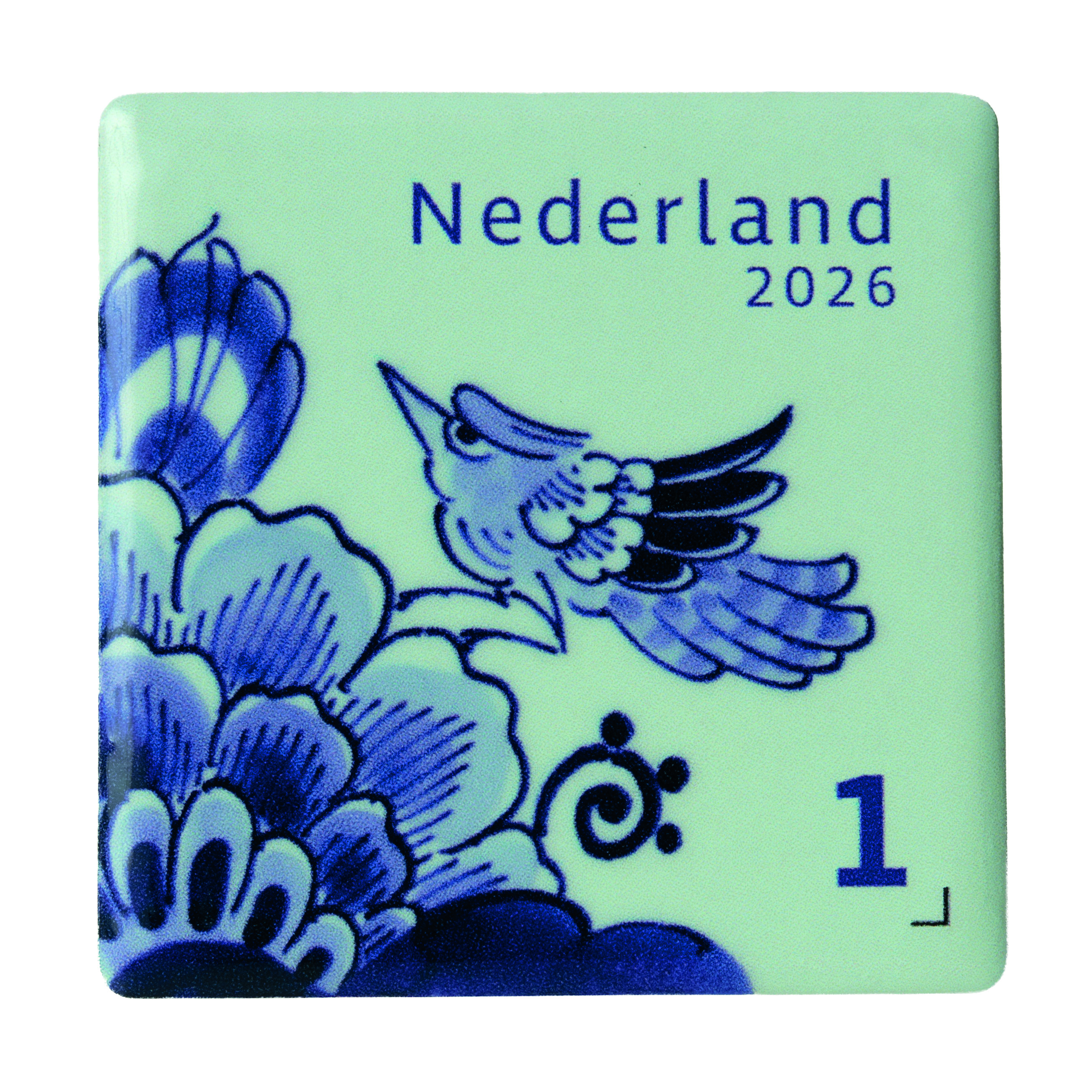
On 7 September 2026, PostNL — in collaboration with Royal Delft, the last surviving Delft faience factory in the Netherlands since the 17th century — launched the Delfts Blauw Keramiekpostzegel (Delft Blue Ceramic Stamp). With this striking issue, PostNL brings out, for the very first time in its history, a postage stamp made of real ceramic, adding a unique collector's item and a historic primeur to Dutch stamp history.
The Delfts Blauw Keramiekpostzegel is more than just a stamp — it is a genuine, thin Delft Blue tile on stamp format. It takes one of the Netherlands' most iconic crafts and brings it to a surprising new size. At 5×5 centimetres with a thickness of 5 millimetres, it is considerably larger and thicker than an ordinary Dutch stamp. The issue comes in a luxe passe-partout packaging, making it a truly special object for collectors of Dutch heritage, design and craftsmanship alike.
A Historic Primeur for Dutch Stamp History
For the first time in its history, PostNL presents a stamp made of genuine ceramic. The striking collaboration with Royal Delft — the only remaining Delftware factory in the Netherlands since the 17th century — results in a unique collector's object in which Dutch heritage, craftsmanship and stamp innovation come together.
Maurice Unck, Director of Mail Netherlands at PostNL: "With this issue, we show that a postage stamp can be much more than a means to frank post. For the first time, we are issuing a stamp made of real ceramic. That makes this issue a special combination of Dutch heritage, innovation and collecting pleasure."
Hessel Hoekstra, CEO of Royal Delft: "For us, this is a special assignment because we are allowed to translate our craft and Delft Blue design into a very special object. PostNL and Royal Delft bring two forms of craftsmanship and creative design together: the rich history of the Dutch postage stamp and the centuries-old tradition of Delft Blue. We are proud of this primeur and of this beautiful stamp."
17th-Century Craftsmanship in Miniature
The decoration of the Delfts Blauw Keramiekpostzegel was designed specifically for this issue. The design shows a floral bouquet with a bird, inspired by motifs that have been used on Delft Blue earthenware at Royal Delft since the 17th century.
The design references the hundred-of-years-old Delft Blue tradition in detail. As Joffrey Waloncker, design manager at Royal Delft, explains, the dark ground of the design is called "Ghost Rock" — stone with cavities in which the spirits of ancestors sit. The little bird also refers to the Delft Blue tradition with its almost cartoon-like appearance, exactly as it was done in the seventeenth century. The design team of Royal Delft created the stamp (with rounded corners), and one of the master painters designed the floral decoration specifically for this issue.
The Story of Delft Blue
Delft Blue finds its origins in the 17th century. Delft potters of the time were inspired by the popular Chinese blue-and-white porcelain. They developed their own form of tin-glazed earthenware with blue decorations. Over time, Delft Blue acquired a wholly Dutch style of its own, featuring depictions of ships, windmills, seascapes and floral motifs — the very imagery that has made it an icon of Dutch culture around the world.
How It Was Made: A Real Ceramic Tile
The stamp tile is pressed from a finely ground mixture of clay, sand and a mineral, which transforms with water into a homogeneous, malleable paste. Under high pressure, half a centimetre-thick "clay cakes" are divided into a large number of square 5×5 cm tile-stamps. After a drying process, they are fired in an oven for a long period at extremely high temperatures of up to approximately 1200 degrees Celsius.
After cooling, the stone-like tiles are coated with a white base layer. Using digital injection printing technology, millions of microscopic ceramic ink droplets are sprayed onto the tile for the decoration, and a transparent glaze layer protects the printed ink. The production process was carried out entirely by Royal Delft.
The Format Family
- Delfts Blauw Keramiekpostzegel (1 NL1) — the standard self-adhesive ceramic stamp with value indication 1 for destinations within the Netherlands, in luxe passe-partout packaging.
- Postzegelmapje 724 (PZM) — the ceramic stamp in a handsome PZM presentation booklet.
- Eerstedagenvelop (EDE) (First Day Cover) — a beautiful first day cover with a specially designed envelope and a "first day of issue" postmark dated 7 September 2026.
- Gestempeld (postmarked) — as ceramics cannot be cancelled with ink in the usual way, the used examples carry a striking half-stamp impression that is applied as an integrated part of the stamp during printing.

The Delfts Blauw Keramiekpostzegel in its luxe passe-partout packaging

Eerstedagenvelop (FDC) with the first-day-of-issue postmark

Postzegelmapje 724 (PZM) — the ceramic stamp in booklet presentation

Postzegelmapje 724 — detail of the booklet and ceramic stamp
Technical Specifications
| Issue Date | 7 September 2026 |
| Issuing Authority | PostNL, in collaboration with Royal Delft |
| Material | Genuine fired ceramic (tin-glazed earthenware) |
| Dimensions | 5 × 5 cm, 5 mm thick |
| Design | Royal Delft design team (master painter's floral bouquet with bird) |
| Face Value | Value indication 1 (NL destinations) |
| Adhesive | Self-adhesive |
| Print Run | Limited (approx. 40,000 pieces) |
Why This Issue Matters
The Delfts Blauw Keramiekpostzegel is a historically significant addition to the philatelic world: it is the first stamp ever produced from genuine Delft Blue ceramic, the result of a unique partnership between a postal operator and one of the Netherlands' most famous craft houses. For collectors of Dutch stamps, Delft Blue, innovative materials or simply beautiful presentation items, this is a genuinely special object.
Because the print run is intentionally limited, the issue is a highly sought-after piece for collectors of PostNL special issues and Collect Club releases alike. The combined appeal of Dutch heritage, centuries-old craftsmanship and stamp innovation makes the Delft Blue Ceramic Stamp a standout highlight of PostNL's 2026 programme.