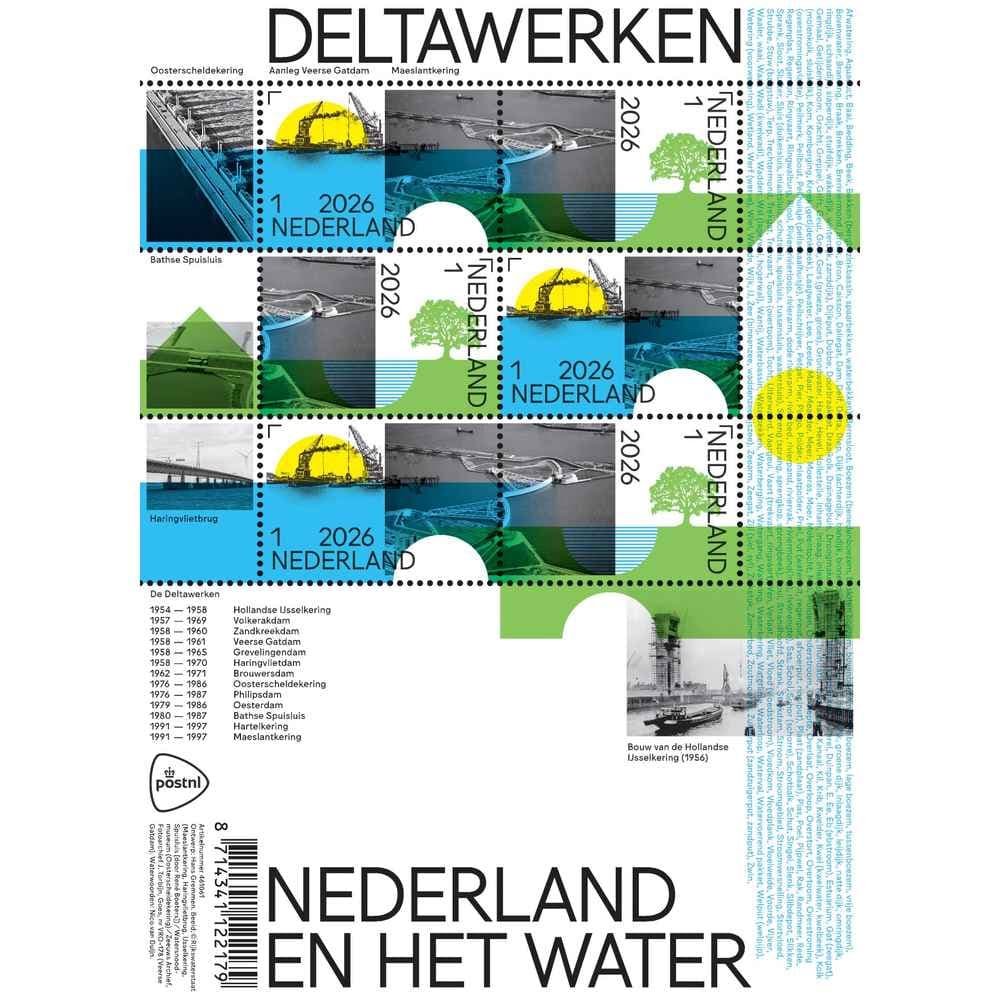
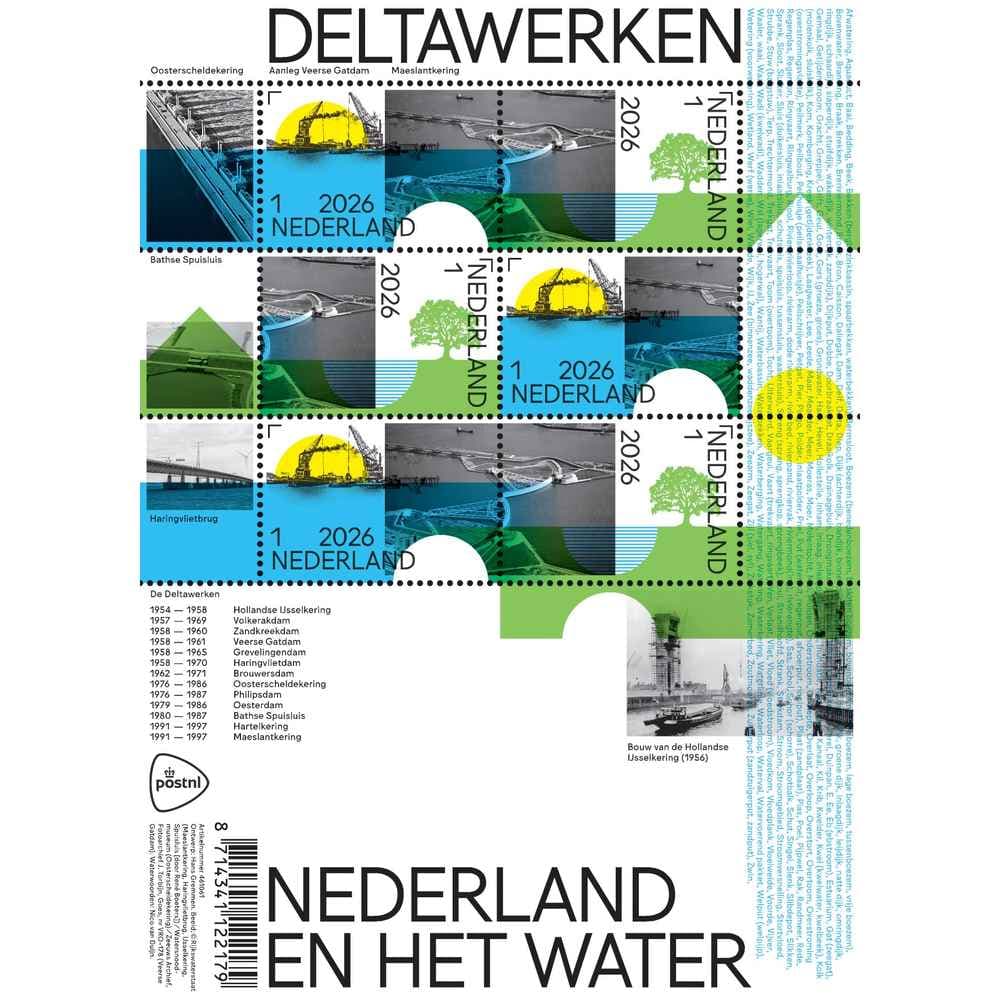
On 5 October 2026, PostNL issues the stamp sheet Deltawerken – Nederland en het water (Delta Works – The Netherlands and water), containing 3 sets of 2 different stamps. The sheet tells the story of how the Netherlands defended itself against flooding after the catastrophic Watersnoodramp (flood disaster) of 1953, and more broadly how the Dutch live with the delicate balance between land and water — a reality shaped by the fact that 60% of the country is vulnerable to flooding and 26% lies below sea level.
The six stamps carry value indication 1 — valid for letters up to 20 grams within the Netherlands — and are issued in a print run of 75,000 sheets. The design by Hans Gremmen combines black-and-white photography with cartographic illustrations in the traditional blue and green tones used to depict water and land.
The Subject: The Delta Works
The Deltawerken form a vast defence system in the southwest of the Netherlands, protecting the land from storm surges originating in the North Sea. Although the dangers had long been discussed, this system of thirteen major dams, storm surge barriers and locks was only built after the devastating Watersnoodramp of 1953. Twenty days after the disaster, the Deltacommissie under Rijkswaterstaat was installed, and less than a year later construction began on the first structure: the Hollandse IJsselkering. The Maeslantkering near Rotterdam was the final piece, completed in 1997.
With five storm surge barriers, two lock complexes and six dams, the provinces of Zeeland, Zuid-Holland and Noord-Brabant are largely cut off from the sea, while the ports of Rotterdam and Antwerp remain accessible. The largest and most challenging project was the Oosterscheldekering. The Delta Works have been declared one of the 7 modern wonders of the world.
Construction Timeline
The build-up of the Delta Works spanned more than four decades, from the first barrier shortly after the flood disaster to the final storm surge barrier closing the system:
- 1954 – 1958Hollandse IJsselkering
- 1956 – 1961Veerse Gatdam
- 1959 – 1960Zandkreekdam
- 1958 – 1965Grevelingendam
- 1957 – 1969Volkerakdam
- 1958 – 1971Haringvlietdam
- 1962 – 1972Brouwersdam
- 1969 – 1986Oosterscheldekering
- 1976 – 1987Philipsdam
- 1979 – 1987Oesterdam
- 1980 – 1987Bathse Spuisluis
- 1991 – 1997Hartelkering
- 1991 – 1997Maeslantkering
Design and Designer
The stamp sheet was designed by Hans Gremmen. "It was quite a puzzle, just to select the photographs. After all, there are many elements such as locks, dikes or bridges, and you want to show as much as possible. Moreover, the area in which the works are located is quite large — it is not just about Zeeland," Gremmen explains. "The first and the last, the Hollandse IJsselkering and the Maeslantkering, had to be on there, I felt, as did the largest work, the Oosterscheldekering. That is the flagship of the Delta Works; I used to visit it as a child to watch it."
"The drawings I used first and foremost show the interplay between land and water," says Gremmen. "As for the tree, I deliberately chose an oak, because it is a native species and the most common tree in the Netherlands. The drawings of the cranes refer to the enormous construction efforts the works required. The prominent sun on the horizon I made part of the whole, because the sun is a hopeful symbol. The sun rises again every day and stands for a new beginning — and the Delta Works were the start of a safer existence. The photographs are black-and-white, and for the illustrations I used, besides the yellow of the sun, the blue and green used in cartography to indicate water and land. Maximum clarity."
Hans Gremmen (Langenboom, 1976) attended the Grafisch Lyceum Eindhoven, followed by graphic design training at the Akademie voor Kunst en Vormgeving St. Joost in Breda and a master's at the Werkplaats Typografie Arnhem, where he studied under, among others, Karel Martens — who also designed a number of stamps. After graduating in 2003, he established himself as an independent designer in Amsterdam. Gremmen is primarily active as a book designer working with architects, artists and photographers. His clients include the Nederlands Fotomuseum in Rotterdam, the Office for Contemporary Art in Oslo, TU Delft, publisher Valiz in Amsterdam and the Zeeuws Museum in Middelburg. Together with Petra Stavast he leads Fw:Books, an independent publisher of books on photography and related subjects. He previously designed the stamp sheet Immaterieel cultureel erfgoed (2024).
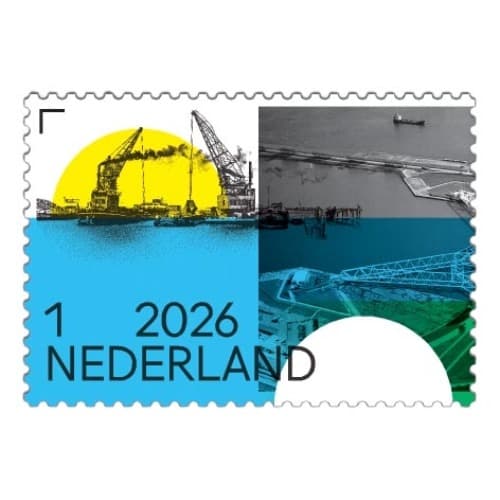
A single Deltawerken stamp from the sheet — black-and-white photography with cartographic colour accents
Technical Specifications
| Title | Deltawerken – Nederland en het water |
| Issue Date | 5 October 2026 |
| Issuing Authority | PostNL |
| Format | Stamp sheet with 3 sets of 2 different stamps (6 stamps) |
| Country of Issue | Netherlands |
| Face Value | 1 — for post up to 20 g within the Netherlands |
| Print Run | 75,000 sheets |
| Stamp Size | 36 × 25 mm |
| Sheet Size | 150 × 108 mm |
| Design | Hans Gremmen, Amsterdam |
| Imagery | Rijkswaterstaat, René Boeters, Watersnoodmuseum, Zeeuws Archief |
| Water Words | Nico van Duijn |
| Colours | Yellow, black, green, blue and metallic |
| Paper | Normal with phosphor print |
| Gumming | Gummed |
| Printer | Koninklijke Joh. Enschedé BV, Haarlem |
| Article Number | 460962 |
Why This Issue Matters
The Deltawerken stamp sheet is a fitting philatelic tribute to one of the greatest engineering achievements in modern history. The Delta Works — spanning from the Hollandse IJsselkering begun in 1954 to the Maeslantkering completed in 1997 — represent over four decades of Dutch ingenuity in the face of an existential threat from the sea.
For collectors of Dutch stamps, engineering and infrastructure themes, maritime subjects, or PostNL Collect Club releases, this sheet is a compelling addition. Hans Gremmen's thoughtful design — balancing documentary photography with symbolic illustration — makes the sheet both a historical record and a work of graphic art in its own right.