The deep sea is calling — all the way down. With the „Marianengraben" (Marianas Trench), Deutsche Post launches a brand-new special stamp series entitled „Der Mensch als Entdecker" (Man as Explorer). The series spotlights extraordinary achievements that expanded — and in some cases permanently changed — our understanding of the world and the cosmos. Humanity seems driven by an innate need to set off for foreign shores, climb the highest mountains, descend to the deepest depths of the Earth and push the limits of our knowledge into unknown territory.
Two products mark the debut: a classic nassklebend (water-activated) stamp sheet featuring a submarine exploring the trench, and a parallel Krypto-Briefmarke — a real self-adhesive German stamp combined with its digital twin on the blockchain. Just like every stamp in the series, the Marianengraben will be available both as a traditional issue and as a crypto stamp with NFT.
The Historic Dive: 23 January 1960
The motif honours one of the greatest feats of deep-sea exploration. On 23 January 1960, oceanographers Jacques Piccard and Don Walsh climbed into the bathyscaphe Trieste and descended for several hours through the Marianas Trench. They finally settled on the sea floor at a depth of 10,916 metres — the lowest point of the world's deepest ocean trench.
What they found surprised the scientific world: complex life forms thrive even in this seemingly inhospitable, pitch-black environment — a sensation almost as great as the dive itself. That pioneering descent lies at the heart of the new stamp motif, which shows "U-Boot beginnt Erforschung des Grabens" (the submarine beginning its exploration of the trench).
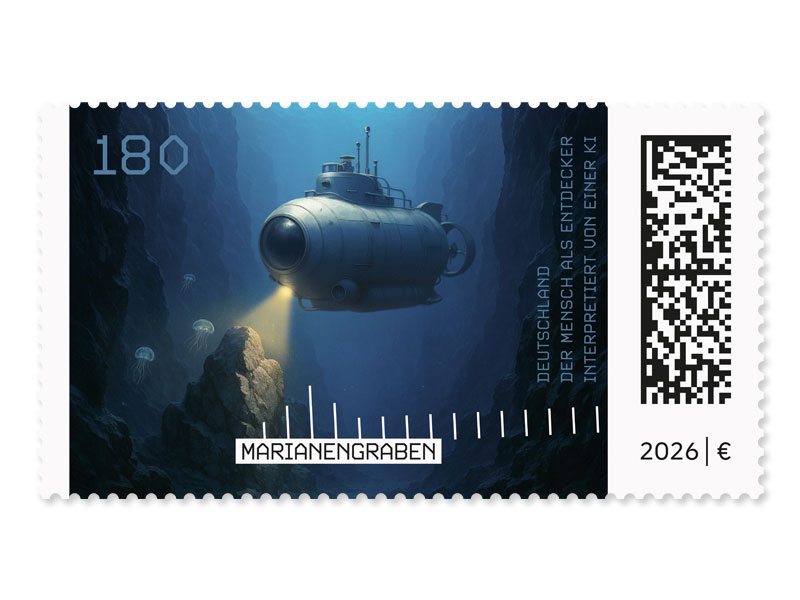
The classic €1.80 stamp sheet (10er-Bogen) showing the submarine beginning its exploration of the trench.
Designed with Artificial Intelligence
In a first for the series, the motif was created using artificial intelligence. The illustration was produced by DALL-E, which draws on data from the internet — photographs, graphics and works of art — to interpret the subject. The generated image is therefore not a faithful, original depiction, but a free artistic interpretation of the Marianas Trench theme. The design was refined by Thomas Steinacker and Jan-Niklas Kröger, Bonn.
The Classic Issue: 1,80 €, 10er-Bogen
The traditional issue consists of ten water-activated stamps at €1.80 each on a sheet suited for franking large letters up to 500 g domestically and compact letters up to 50 g internationally. Each stamp carries a matrix code, and the sheet is printed on coated, white, fluorescent postage stamp paper DP II in multicolour offset by the Bundesdruckerei GmbH, Berlin. The sheet shows two stamps side by side and five below one another, with the EAN code placed on all four margin pieces of the narrow sheet side.
The Krypto-Briefmarke: A Real Stamp + NFT
The crypto edition is a combination of a genuine self-adhesive German stamp and its digital twin, a digital image whose authenticity is guaranteed by blockchain technology. Every Krypto-Briefmarke contains a self-adhesive SPWZ (special postage stamp value) of €1.80 plus the appropriate NFT. With your purchase you receive the access information needed to become the owner of a unique, digital collector's item on a blockchain — so you can also present and collect your stamp digitally.
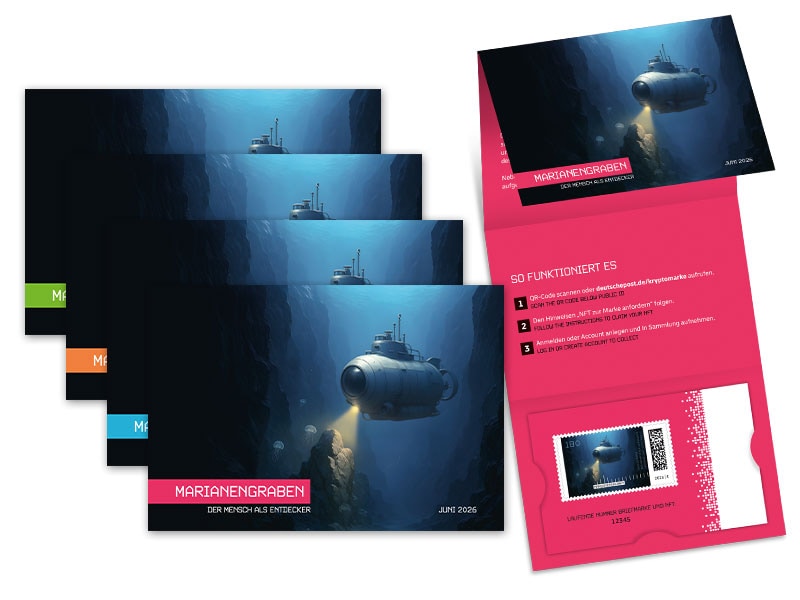
Marianengraben
The submarine shines its spotlight on the rocks in the free AI interpretation of the trench shown on the envelope artwork.
Self-adhesive SPWZ, €1.80 + NFT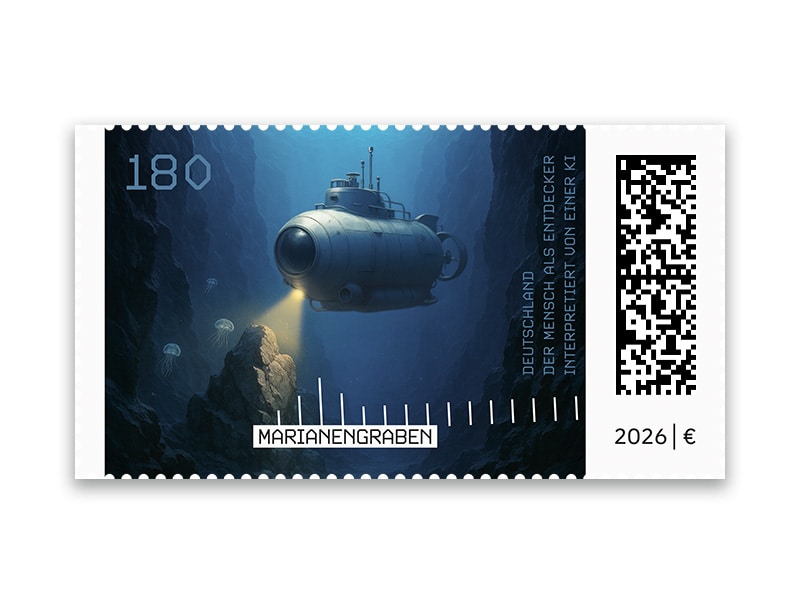
Four Colours, Randomly Assigned
The product design varies in pink, blue, purple and yellow — and these colour variants also appear in the minted NFTs.
Colour assigned at randomRarity Levels
The Krypto-Briefmarke is produced in four colour variants with different rarity levels. The self-adhesive stamp inside is always the same motif; it is the colouring of the product design that varies. A colour choice is not possible at the time of order — the stamp is dispatched at random in a neutral, sealed envelope. Once the envelope has been opened after purchase, the statutory right of withdrawal lapses and returns are excluded (maximum order: 10 pieces).
Quick Facts — Marianengraben
| Series | Der Mensch als Entdecker (Man as Explorer) |
| Motif | U-Boot beginnt Erforschung des Grabens (Illustration: DALL-E) |
| Designers | Thomas Steinacker and Jan-Niklas Kröger, Bonn |
| Classic Issue Value | €1.80 per stamp — 10er-Bogen, water-activated |
| PWZ Format | 55.00 × 30.00 mm |
| Sheet Format | 130 × 170 mm (2 stamps beside, 5 below) |
| Printed By | Bundesdruckerei GmbH, Berlin — multicolour offset on DP II paper |
| Issue Date | 11 June 2026 |
| Crypto Stamp | Self-adhesive SPWZ €1.80 + NFT, 4 colour variants / rarity levels |
| Historical Dive | 23 Jan 1960 — Piccard & Walsh in the Trieste, 10,916 m |
Why Collectors Care
The Marianengraben is notable on several fronts at once. It opens a completely new thematic series, marks Deutsche Post's continued commitment to phygital, AI-assisted stamp design, and repeats the successful dual-issue pattern of a classic stamp alongside a crypto stamp with NFT. For thematic collectors of sea depths, oceanography, exploration history or blockchain philately, the AI interpretation and the colour-rarity game of the crypto edition add an extra layer of fun — even without any previous crypto expertise.
Inquire About This Collection Explore More Stamps at Philately World