The Deutsche Post Krypto-Briefmarke (crypto stamp) is one of the most talked-about innovations in German philately since 2023. Each Krypto-Briefmarke is a phygital collector's item: a real, self-adhesive German special stamp value (SPWZ) combined with a digital twin — an NFT whose authenticity is guaranteed by blockchain technology. Since the programme began, every edition has followed the same clever recipe, and two thematically rich series have grown out of it.
The launch of "Historische Bauwerke in Deutschland" (Historical Buildings in Germany) in November 2023 made Deutsche Post the first postal operator to combine a real stamp with an AI-generated motif and a blockchain twin. The series ran for five editions — from the Brandenburg Gate to the Semperoper — before a brand-new series, "Der Mensch als Entdecker" (Man as Explorer), opened in June 2026 with the Marianas Trench. Here is the whole programme, issue by issue.
One Edition, Two Worlds: Real Stamp + NFT
A Krypto-Briefmarke always combines a genuine self-adhesive German stamp with its digital twin — a digital image linked to an NFT whose authenticity is guaranteed by blockchain technology. With the purchase you receive the access information that allows you to become the owner of a unique, digital collector's item on a Ciphers.me account — Deutsche Post's cooperative partner platform and an innovation of the Dutch security printer Royal Joh. Enschedé, whereby the NFT is minted on the Polygon blockchain. This way you can present and collect your crypto stamp digitally as well.
Since the Kölner Dom edition, each issue has appeared in four colour variants with different rarity levels. The self-adhesive stamp itself is always identical; only the colouring of the product design — and the matching NFT — varies. A pink product, for example, goes with a pink NFT. Choosing a colour at order time is not possible: the crypto stamp is dispatched at random in a neutral, sealed envelope. Once the envelope has been opened, the statutory right of withdrawal lapses and returns are excluded (maximum order: 10 pieces per edition).
Series One: Historische Bauwerke in Deutschland (2023–2025)
The first series took German landmarks into the digital age. Every motif was interpreted by artificial intelligence — never a photorealistic copy, but the AI's own vision of the building, with deviations deliberately accepted and not "corrected" by human hands. Each of the five editions also appeared as a classic, water-activated stamp without NFT; the crypto versions added the phygital layer.

Brandenburger Tor
The start of it all — the first German Krypto-Briefmarke and the first AI-generated Deutsche Post motif. The strongly simplified, pixel-edged Berlin gate marks a national symbol that has stood from Prussian times to the symbol of German unity.
Booklet, self-adhesive SPWZ €1.60 + NFT · art 150305481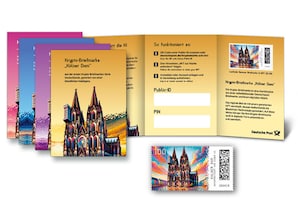
Kölner Dom
The UNESCO World Heritage cathedral introduced the four colour variants with rarity stages and a reduced edition of 100,000 copies. Here, the graphic artist "keeps the last word — and the last click" over the AI.
Self-adhesive SPWZ €1.00 + NFT · art 150305523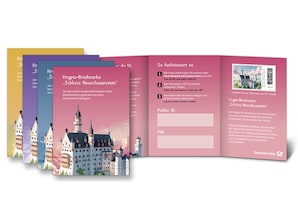
Schloss Neuschwanstein
King Ludwig II's fairy-tale castle near Füssen — his stone homage to the Middle Ages, born from the Grail sagas and the music dramas of Richard Wagner. The AI deliberately draws its own fantasy version of the "Neue Burg Hohenschwangau".
Self-adhesive SPWZ €2.75 + NFT · art 150305524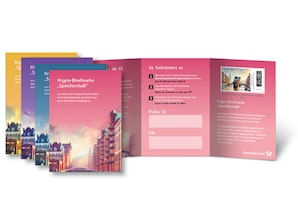
Speicherstadt Hamburg
UNESCO World Heritage since 2015 and under heritage protection since 1991 — the largest self-contained, uniformly designed warehouse complex in the world, built between 1883 and 1927 in Hamburg's free port.
Self-adhesive SPWZ €0.95 + NFT · art 150305541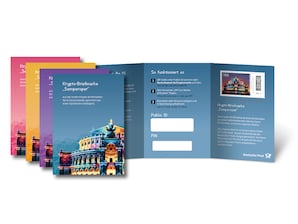
Semperoper Dresden
The grand finale of the architecture series: Dresden's famous opera house, which burned down almost completely in the night of 13 February 1945 and returned faithfully reconstructed in 1985 — a lamp of German cultural history.
Self-adhesive SPWZ €1.80 + NFT · art 150305553Series Two: Der Mensch als Entdecker (from 2026)
With the Marianengraben (Marianas Trench), Deutsche Post launched a brand-new series in June 2026: "Der Mensch als Entdecker" (Man as Explorer). It presents outstanding events that expanded — and in some cases permanently changed — our understanding of the world and the cosmos. The subscription seems to be a basic need of our species: setting off for foreign shores, climbing the highest mountains, descending into the deepest depths of the earth and pushing the boundaries of knowledge into unknown territory.
The Marianengraben crypto stamp (€1.80 SPWZ, issued 11 June 2026) was limited to 50,000 copies and introduced a new colour scheme with its own rarity stages — pink 5%, blue 10%, green 35% and orange 50%. As the very first cryptographic edition, the motif, a submarine whose spotlight scans the rocks of the trench, was interpreted by the AI DALL-E. A second series issue, themed around the Himalaya, is already announced for 1 October 2026.
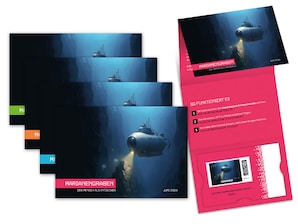
Marianengraben
Opens "Der Mensch als Entdecker" — a free DALL-E interpretation of the world's deepest ocean trench, with rarity tiers in pink, blue, green and orange.
Self-adhesive SPWZ €1.80 + NFT · art 150305588The Album: Historische Bauwerke in Deutschland
Completing the programme is the official showcase album (art no. 150402025, €39.90): a high-quality, foil-finished hardcover album in the classic format 21 × 21 cm, with unstocked insert pockets for all five crypto stamp editions of the "Historische Bauwerke in Deutschland" series issued so far. As exclusive bonus material, the album holds the bonus NFT "Reichstagsgebäude" and a hologram of the 1986 Reichstagsgebäude Berlin stamp, together with all five special stamps of the series (Bund 2023–2025, mint in protective mounts).
The bonus NFT rounds off the architecture series with the most moving German building of all: the Reichstag in Berlin. Built 1884–1894 in Neo-Renaissance style to the plans of Paul Wallot, it saw Philipp Scheidemann proclaim the Republic and the end of the monarchy from one of its balconies in 1918. The Reichstag fire of 1933 then served the National Socialists as a pretext for dismantling the rule of law. After the reunification, the Reichstag returned to the heart of German democracy with its iconic glass cupola, completed in 1999.
The first German Krypto-Briefmarke — Brandenburger Tor (2023)
The first coloured rarity-staged edition — Kölner Dom (2024)
Schloss Neuschwanstein (2024) — the fairy-tale castle of Ludwig II
Speicherstadt Hamburg (2025) — the UNESCO warehouse city
Semperoper Dresden (2025) — the grand finale of the architecture series
Marianengraben (2026) — the first issue of "Der Mensch als Entdecker"
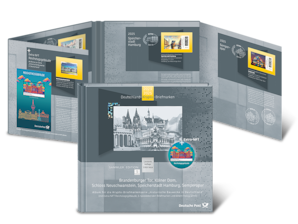
The official album "Historische Bauwerke in Deutschland" with bonus NFT "Reichstagsgebäude" and 1986 stamp hologram
The Programme at a Glance
| Programme | Two series — "Historische Bauwerke in Deutschland" (2023–2025, 5 editions) and "Der Mensch als Entdecker" (from 2026) |
| Concept | Crypto stamp = real self-adhesive SPWZ + NFT digital twin on the blockchain; also issued as classic water-activated stamps without NFT |
| Blockchain / NFT | NFTs minted via Ciphers.me (innovation by Royal Joh. Enschedé) on the Polygon blockchain |
| Design | AI-generated motifs (incl. DALL-E) — the graphic artist keeps the last click/word |
| Rarity Levels (2024–2025) | Pink 2% · Blue 10% · Purple 25% · Yellow 63% (edition e.g. Kölner Dom: 100,000) |
| Rarity Levels (2026–) | Pink 5% · Blue 10% · Green 35% · Orange 50% (Marianengraben: edition 50,000) |
| Prices | €9.90 per crypto edition (stamp face values €0.95–€2.75) · maximum 10 pieces per edition |
| Collector Album | €39.90, 21 × 21 cm hardcover with pockets for all 5 editions, bonus NFT "Reichstagsgebäude", 1986 stamp hologram and the 5 series stamps (mint) |
Why This Programme Matters
The Krypto-Briefmarken are a historic first for German philately: Deutsche Post combined a real, franking-valid self-adhesive stamp with a blockchain twin, and did so through AI-generated design. The combined appeal of heritage architecture, algorithmic art and the colour-rarity game has turned every edition into a small lottery of collectability — a pink Dom or a blue Marianas Trench leaves the printer as an instantly recognisable rarity tier.
For collectors of German special stamps, AI art, phygital or crypto philately — or simply of five unforgettable German landmarks — the programme offers a vivid bridge from classic stamp collecting into the digital age. With the new "Der Mensch als Entdecker" series, the story is only just beginning.
Inquire About the Krypto-Briefmarken Explore More Stamps at Philately World